
Blockchain technology has introduced radically new economic paradigms, yet access to these markets remains hindered by significant technical barriers. Developing a decentralized application (DApp) from scratch requires rare skills: from Rust programming for smart contracts to secure cryptographic key management, to optimizing frontends for blockchain interaction without frustrating latency. In this context, the “White Label” model emerges not just as a commercial strategy, but as a necessary software architecture to scale Web3 adoption.
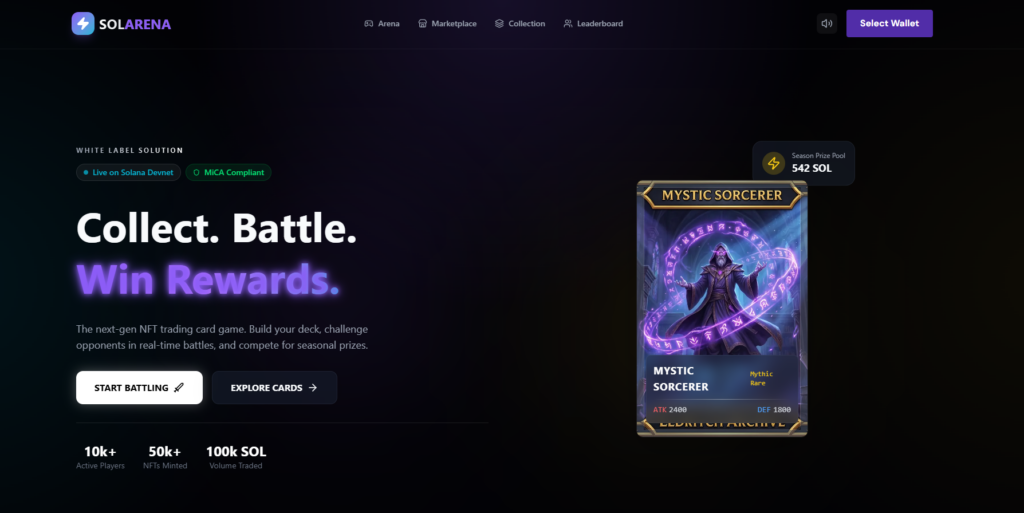
This article technically analyzes how a modern White Label NFT game engine is built, using SolArena as a case study. SolArena is a “battle-tested” application enabling the rapid launch of a collectible card game (TCG) on the Solana blockchain. We will dissect its technology stack to understand how engineering choices enable the modularity, security, and scalability required for a product designed for rebranding and mass distribution.
This is not a sales brochure, but a “under the hood” journey for CTOs, developers, and digital entrepreneurs who want to understand how an on-chain gaming platform actually works.
1. The Context: Why White Label in Web3?
In a technological context, the term “White Label” defines a “turnkey” software infrastructure, engineered by a specialized provider to be acquired, branded, and distributed by third-party companies as if it were their own proprietary product. While this model is consolidated in Web2 (think Shopify e-commerce or generic CRMs), in Web3 it assumes critical structural importance due to the vertical scarcity of engineering skills.
A blockchain game requires three different layers of engineering that must communicate perfectly:
- Protocol Layer: Smart Contracts (in this case on Solana) managing immutable logic.
- Application Layer: The web or mobile user interface managing wallets, signatures, and asynchronous state.
- Data Layer: Indexing of on-chain data (often slow to query directly) for a fast user experience.
SolArena was designed to abstract this complexity. The solution buyer doesn’t need to know what a CPI (Cross-Program Invocation) is or how to handle Borsh data serialization. They only need to configure economic and graphic parameters. Let’s see how.
2. Technical Architecture: Under the Hood
To make a blockchain game truly “White Label” – capable of being branded and launched by third parties without touching core code – the architecture must be rigorously modular. SolArena adopts a full-stack approach cleanly separating on-chain business logic from the off-chain user interface.
The Core Frontend: Next.js 16 & React 19
The touchpoint between the user and the blockchain is the frontend. SolArena uses Next.js 16 with React 19, a choice dictated not by trends, but by the need for performance and robustness, leveraging latest features like Server Actions and the Turbopack compiler.
- State Management with Zustand: In a DApp, state is intrinsically complex and asynchronous. There isn’t just UI interface, but also blockchain state (pending transactions, confirmations, finalized slots, RPC errors). SolArena implements Zustand to manage this state reactively and lightly. Unlike Redux, which can be verbose, Zustand allows creating isolated “stores” for the wallet, current battle, and NFT inventory, avoiding useless re-renders that often plague heavy Web3 apps and ensuring 60fps even during combat animations.
- Agnostic Wallet Integration: Using standard
@solana/wallet-adapterlibraries, the system natively supports Phantom, Solflare, Backpack, and other Solana wallets. The architecture manages authentication not via traditional login (email/password), but via cryptographic message signing (SIWS – Sign In With Solana), ensuring user identity is always verifiable on-chain without needing centralized databases vulnerable to password leaks. - Atomic Design System with TailwindCSS 4: For a white label product, aesthetic flexibility is vital. Using TailwindCSS 4 allows defining a configuration file (
tailwind.config.ts) with semantic design tokens (e.g.,colors.primary,spacing.card-padding). Changing the game’s visual identity from “SolArena” to a hypothetical “GalacticBattles” doesn’t require rewriting CSS components, but simply updating these global variables. React components are built to inherit these tokens, automatically adapting buttons, cards, and layouts to the new brand.
Smart Contracts & Backend: Anchor Framework
The true beating heart of the system resides on the Solana blockchain, programmed in Rust using the Anchor framework. Anchor is to Solana what Ruby on Rails was to Web 2.0: it provides a secure (“sealevel”) and opinionated structure that drastically reduces the attack surface for common bugs and exploits like reentrancy attacks or missing signer verification.
Matchmaking: Hybrid On-Chain/Client-Side
SolArena implements a hybrid system balancing decentralization and performance.
- The On-Chain Queue (PDA): Queue entry happens on-chain, ensuring economic commitment (entry fee) and game intent are immutable and verifiable.
- Client-Side Smart Load Balancer: Instead of an expensive on-chain “crank”, the client uses an intelligent algorithm (Smart Load Balancer) that queries available PDA queues to find the fastest match (e.g., queues with a single waiting player). This approach reduces network fees and matching latency.
3. The Digital Asset Economy
A Web3 game is not such without true asset ownership. SolArena integrates the Metaplex standard, the dominant protocol for creating and managing NFTs on Solana, to transform game cards into real financial assets.
Card Tokenization and Metadata
Each game card is not a simple row in a proprietary SQL database, but a unique token (Technical Spec: SPL Token with Metadata Extension) in the user’s wallet.
- On-Chain vs Off-Chain Metadata: To optimize costs, SolArena uses a hybrid approach. Image and narrative description (“lore”) reside on Arweave (permanent decentralized storage), while vital game statistics (Attack, Defense, HP, Level) can be stored directly in on-chain metadata or a PDA account associated with the NFT mint. This means if a user sells the card, they also sell the progress, experience (XP), and boosted stats associated with it. Time spent playing crystallizes into asset value.
- Dynamic and Verifiable Rarity: The minting system uses oracle-based random generation algorithms (like Switchboard or previous block hash, with security cautions) to assign rarity (Common, Rare, Legendary, Mythic) at creation time. This creates a real, non-simulated digital scarcity economy. A “Mythic” edition is mathematically proven to be rare, creating a speculative secondary market based on mathematical trust.
Marketplace with Sequential Settlement
To manage dynamic asset trading complexities, the engine uses a performant hybrid settlement model:
- On-Chain Payment: The buyer sends funds (SOL) and platform fee in a verifiable blockchain transaction.
- Asset Delivery via API: Upon confirmation, an authorized backend service (Admin Authority) executes the minting or transfer of the NFT to the buyer’s wallet. This design (Sequential Settlement) allows offering an instant user experience (“Optimistic UI”) similar to Web2 e-commerce, while maintaining the security of tracked and irrevocable payments on Solana.
4. The White Label Model: Modularity by Design
Let’s analyze what makes SolArena a “White Label” product from a software engineering perspective. The challenge is creating code generic enough to adapt to different brands, yet specific enough to work out-of-the-box.
Configuration Abstraction (Configuration over Implementation)
In the Anchor program Rust code, critical constants are not “hardcoded”, but defined in a global configuration account initialized at deployment.
// Conceptual example of on-chain configuration data structure
#[account]
pub struct GameConfig {
    pub admin_key: Pubkey,        // Who can change rules
    pub treasury_key: Pubkey,     // Where profits go
    pub entry_fee: u64,           // Cost to play (in lamports)
    pub mint_price: u64,          // Cost to buy cards
    pub match_timeout: i64,       // Max game duration
}
This design pattern allows the game launcher to modify entry prices or treasury addresses by sending a simple update transaction, without needing to recompile code or redeploy the smart contract—a risky and expensive operation.
Automated Deployment Scripts
One of the biggest barriers in blockchain white labeling is “Deployment Hell”. SolArena solves this with a suite of TypeScript scripts (/scripts/initialize-queue.ts, /scripts/deploy.ts) orchestrating the launch. These scripts don’t just upload bytecode to the network, but execute the “initialization ceremony”:
- Create necessary global PDA accounts.
- Load initial card sets (“starter decks”).
- Configure authorities.
- Generate a frontend configuration JSON file. This transforms a process requiring 4 hours of manual work by an expert engineer into a single command:
npm run deploy:full.
Business Logic Isolation
Combat logic (who wins, how much damage a card deals) is isolated in specific Rust modules. If a white label client wants to change game rules (e.g., from “highest attack wins” to “rock-paper-scissors”), they only modify the battle_logic.rs module, without risking breaking the payment system or NFT management residing in separate modules. This separation of concerns is crucial for long-term maintainability.
5. Technical Challenges and Solutions in Web3 Gaming
Developing SolArena required overcoming specific challenges at the intersection of real-time gaming and asynchronous blockchain. Here’s how they were solved, providing valuable lessons for any similar project.
The Latency Problem (Latency vs Finality)
Solana is fast (400ms blocks), but not “instant” like a centralized WebSocket server. Users can’t wait 2 seconds to see an attack effect. Solution: Optimistic UI Updates. SolArena’s frontend applies the “optimistic update” technique. When a player clicks “Attack”:
- The UI immediately plays the attack animation and reduces opponent health locally.
- In the background, the transaction is sent to the blockchain.
- If adding the transaction fails (rare case), the UI executes a “rollback” to the previous state and shows a discreet error. This makes the game feel fluid (“snappy”) like a Web2 app, hiding blockchain complexity from the end user.
User Onboarding: “Wallet Friction”
Asking a casual player to install Phantom, buy SOL on an exchange, transfer it, and manage gas fees is the best way to lose 95% of users at step one. Solution (in roadmap): Account Abstraction & Gas Relayers. The architecture is ready to support “Gasless” transactions. The game administrator can configure a backend “Fee Payer” covering transaction fees for users. Players simply sign the intent to move a card, but don’t pay SOL. This enables real “Free-to-Play” models, where users start playing without owning crypto, interacting with the blockchain unknowingly.
Cost Management and “Rent”
Every byte of data saved on Solana costs “Rent” in SOL. A game with millions of historical matches would risk costing a fortune in storage. Solution: Aggressive Account Closing. The protocol implements rigorous cleanup logic. Once a match concludes and a winner is declared, the match account (“Game Account”) is programmatically closed. The protocol includes a close_game instruction that not only deletes data but returns the deposited “Rent” to the player or treasury. This SOL recycling makes the game economically sustainable, funding new matches with residues from old ones.
6. Use Cases: Who Should Adopt This Technology?
It’s not just for crypto startups. This white label architecture enables transversal use cases.
- Brands and Loyalty Programs: A fashion brand can launch a game where cards are its digital products. Playing and winning unlocks real discounts or exclusive drops. NFT infrastructure ensures “loyalty points” are tradable assets, creating a secondary loyalty market.
- DAO Communities and NFT Collections: Existing NFT collections (e.g., 10,000 profile pictures) often suffer from lack of utility. Integrating SolArena, a collection can transform static JPEGs into playable characters, giving new life and value to the project without hiring a Rust team.
- Events and Conferences: Event organizers can create temporary white label tournaments. Attendees receive a temporary wallet at entry, play during the event to win physical prizes, and everything is tracked on-chain to ensure no cheating in prize assignment.
7. Conclusions and Future Outlook
The era of “Walled Gardens”, where game data and assets belong to the developer, is ending. The White Label model on blockchain represents a bridge to the future of interoperable gaming.
SolArena demonstrates it is possible to build high-quality, fast, and fun user experiences while preserving the promise of decentralization: asset self-custody, rule transparency, and open markets.
