
In the world of alternative investments, luxury cars (especially hypercars and vintage icons) have proven to be one of the most consistent assets for appreciation over the last two decades, often outperforming gold and traditional stock markets. However, the market has always been ultra-exclusive.
The Paradox of Accessibility
Purchasing a rare Ferrari requires not only capital (often exceeding $500,000) but also access to exclusive dealer networks, storage costs in temperature-controlled environments, specialized insurance, and meticulous maintenance. Tokenization via AurumRWA transforms this barrier into an opportunity: the car becomes a liquid, fractional, and accessible asset.
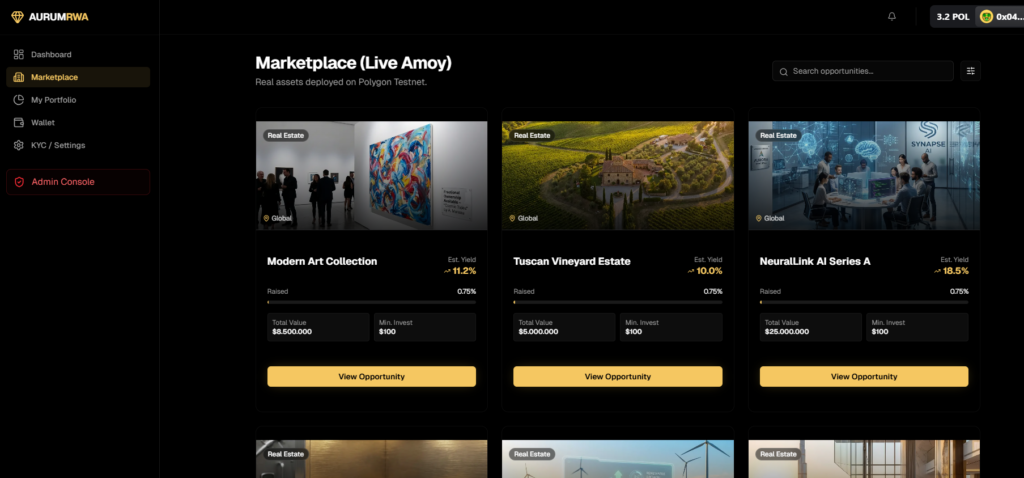
Case Study: Ferrari SF90 Stradale – From Track to Token
Let’s analyze the concrete case of a luxury dealer who decides to use a white label platform to tokenize a Ferrari SF90 Stradale.
Asset Metrics
- Market Value: $600,000 (estimated including 2 years of management costs).
- Token Structure: 6,000 tokens are issued (SF90-TKN).
- Price per Token: $100.
- Underlying: The physical car remains in the dealer’s vault, but legal ownership is tied to token holders via a smart contract.
Data and Transparency: The “Digital Twin” of the Car
To guarantee the value of the token, the platform creates a “digital twin” of the car. Each token represents not just a financial stake, but is intrinsically linked to the vehicle’s history.
- VIN (Vehicle Identification Number): Immutably recorded on-chain.
- Maintenance Logs: Uploaded as
AssetDocument(e.g., official Ferrari service records). - Certificates of Origin: Documents certifying originality and condition.
Physical Management and Storage
One of the most complex aspects of luxury car tokenization is maintaining its state of preservation. The platform manages “Maintenance Records” through an encrypted file system:
- Climate-Controlled Storage: Each asset includes a storage clause in specialized vaults.
- Fully Comprehensive Insurance: Policies covering replacement value, not just market value, to protect investors.
- Third-Party Inspections: Bi-annual appraisals uploaded on-chain to validate that the asset still exists and is in mint condition.
The White Label Platform for Dealers and Collectors
Why should a dealer choose AurumRWA’s White Label solution? The answer lies in scalability.
- Immediate Liquidity: The dealer can liquidate the asset while maintaining physical management and visibility in their showroom.
- Global Customer Base: They can sell to thousands of enthusiasts worldwide instead of waiting for a single millionaire buyer.
- Cross-Selling: The platform becomes a constant touchpoint with customers for other services (e.g., rentals, pre-sales).
Step-by-Step: How to Buy Tokens (The Transactional Layer)
The purchase process on AurumRWA is designed to be “bank-grade” yet intuitive.
Step 1: Onboarding and Compliance
The user must connect their wallet and pass KYC. For luxury cars, the whitelisting check is crucial to ensure the investment complies with local luxury asset regulations.
Step 2: Approval (USDC Allowance)
The user uses USDC (a dollar-pegged stablecoin). Before purchasing, they must authorize the AssetOffering smart contract to withdraw the necessary amount. This protects the user from unauthorized transactions.
Step 3: Purchase Execution
The user enters the amount (e.g., $1,000 for 10 tokens). The platform calls the on-chain function that transfers USDC to the dealer and instantly sends SF90-TKN tokens to the investor’s wallet.
Step 4: Digital Ownership and Portfolio Tracking
Once the on-chain transaction is confirmed, SF90-TKN tokens appear immediately in the user’s dashboard. This is the definitive “Proof of Holding”: not a paper certificate, but an immutable record on the Polygon blockchain attesting to fractional ownership of the asset.
6. Post-Purchase Journey: Monitoring and Dashboard
The investor can monitor the value of their share in real-time and access updated documentation of the car through the platform’s dashboard portal.
Governance and “Benefits” for Token Holders
Tokenizing a car is not just about owning a serial number. The platform enables unique experiences and rights:
- Resale Voting: Investors may be called to vote on whether or not to accept a purchase offer for the physical car or to wait for a different auction.
- Exclusive Access: Owning a specific amount of tokens can unlock the “Utility Layer”: invitations to factory tours, track days, or previews of new models at the dealer.
Technical Architecture: Smart Contracts and Asset Security
Everything rests on the robustness of the code. The platform uses open and audited standards:
- RWAAsset.sol (ERC-20 + Snapshot): The contract representing the car. It handles snapshots for dividends and the immutability of ownership records.
- AssetFactory.sol: The white label engine that allows the dealer to launch new assets (e.g., a Lamborghini Revuelto after the SF90) with one click.
- DividendDistributor.sol: Manages the pro-rata distribution logic for rental profits.
Compliance and Legal Framework: MiCA applied to Passion Assets
Although cars are physical goods, the token representing them is protected by an on-chain compliance layer:
- ComplianceRegistry.sol: Every transfer (including P2P) is verified in real-time. If the recipient hasn’t passed KYC, the transaction fails automatically at the protocol level.
- Custody & Storage: Binding legal agreements ensure the physical car is insured and maintained according to agreed standards.
Exit Strategies and Liquidity: From P2P to Liquidation
One of the primary challenges of physical assets is liquidity. The AurumRWA platform addresses this through two real operational mechanics.
Option A: Peer-to-Peer (P2P) Transfer
Since SF90-TKN tokens are standard ERC-20, users can sell them privately to any other whitelisted investor on the platform. The transfer occurs directly via the wallet’s transfer function. The asset’s smart contract instantly verifies if the recipient is in the ComplianceRegistry. If so, ownership changes hands in seconds.
Option B: Physical Asset Redemption (Final Exit)
The investment plan includes a predefined term (e.g., 24-36 months). At the end, the dealer proceeds with the sale of the physical car.
- Physical Sale: The SF90 car is sold on the traditional market.
- Pro-Rata Distribution: Proceeds are converted to USDC and deposited on-chain in the distributor.
- Burn & Payout: Investors redeem their tokens and receive the final capital (investment + gain).
Passive Income: Dividends and Rental Yield
Beyond capital appreciation, the strength of luxury car tokenization lies in generating passive income.
Case Study: “Luxury Rental Program”
A dealer may decide that the tokenized car (e.g., Ferrari SF90) shouldn’t just be on display but should participate in premium rental programs (corporate events, exclusive test drives).
- Consolidated Revenue: The car generates, for example, $20,000 in annual net profit from rentals.
- Dividend Deposit: The dealer periodically deposits these USDC into the
DividendDistributorsmart contract. - Automatic Distribution: Thanks to snapshot logic, each token holder automatically receives a share of these $20,000 in their wallet, in proportion to the number of tokens held.
This transforms the car from a “static asset” into a true income-generating machine, where the investor earns while the car is on the road, without having to manage rental logistics.
Scalability and Future: Fractionated Luxury Fleets
AurumRWA’s White Label allows for the creation of entire “Automotive Funds.” An investor, instead of putting everything into a single Ferrari, can diversify their capital across a fleet: 10% Ferrari, 10% Lamborghini, 10% vintage Porsche.
Conclusion: A New Standard of Investment
Luxury car tokenization is not science fiction, but an operational reality made possible by the platform. Through the clever use of blockchain, we have transformed a hobby for the few into an asset class for the many.
The perfect tool for dealers who want to innovate and for investors who want to dream, one token at a time.
